2mm/N Gauge
Presented by Farnham & District Model Railway Club
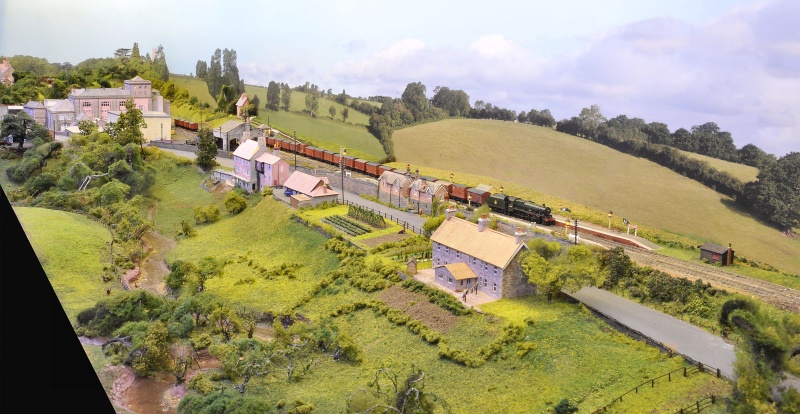
Wickwar is a small town on the important secondary main line between Bristol and Gloucester; modelled as it was around the early 1950s. The small goods yard was removed in 1963 and the station was closed in 1965, though the line is still heavily used. The Bristol and Gloucester Railway was built under the guidance of Brunel as broad gauge, opened in 1844, the GWR expected to buy it, but in 1845 the midland outbid them breaking the GWR’s monopoly of Bristol. It was transferred from BR(M) to BR(W) in 1957.
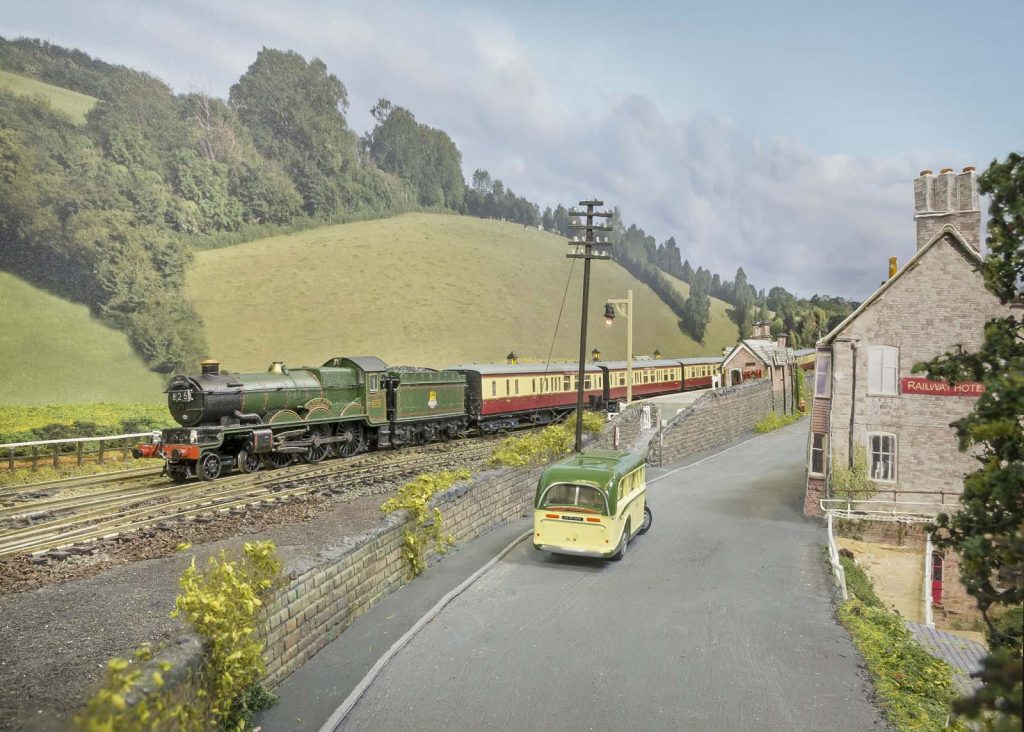
As well as local trains, there were many long distant expresses with destinations such as Plymouth, Bournemouth, Manchester, Bradford and Newcastle. Goods trains were mostly to or from Bristol or Avonmouth docks. Motive power was mainly LMR tender locos, eg 4Fs, Jubilees, and Black 5s, with a few GWR and (later) LNER locos. We aim to reproduce a typical selection of trains and stock for the time.
To the south-west [left as seen] the line comes out of a tunnel and along the side of a valley; to the north-east [right] it starts to cross the valley. There is a 30m height difference between the highest and lowest parts modelled (8” in N) so open plan baseboards have been used, built from Styrofoam sandwiched between 3mm layers of Gaboon ply. Styrofoam has also been used for the scenery, covered with a layer of Sculptamold.
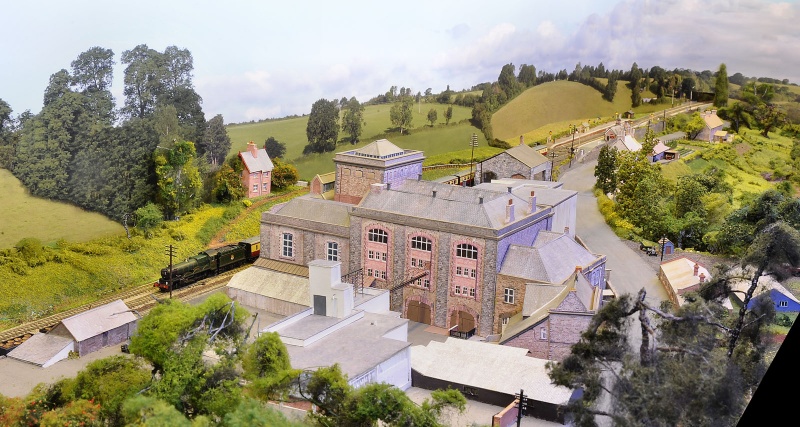
All the buildings are scratch-built, many from printouts of photos of the current buildings. The station building, designed by Brunel, was unique due to the narrow space. Next to the tunnel is the large brewery, built by the railway company to replace existing breweries whose water supply the tunnel cut through. At the period modelled it had become a cider factory, which later closed but has now reopened as the Wickwar Brewing Company. The backscene was ‘Photoshopped’ from photographs of the real location and printed on vinyl.
Each of the 2 tracks can operate DC or DCC, elected when the layout is set up. The small goods yard only had 1 train per day; to do any shunting necessitated blocking both main lines. The fiddle yard has 3 roads in each direction; each divided into sections so that 24+ trains can be stored. The movement of trains in the fiddle yard is automated using MERG Train On Track (TOTI) detectors which work with both DC and DCC. The boards and control panels are connected via a MERG CBUS system. Points, signals, and the car system are controlled by servo motors in MERG mounts, the signals are operated automatically as trains pass. Video camera display views of the layout on screens at each end. RFID is used to automate whistle signals.
Lorries and buses run along the front using the Faller moving vehicle system (internal battery), with a ‘taxi rank’ at one end storing up to vehicles. The vehicles are controlled from a tablet connected by WiFi, and RFID is used to identify and display where vehicles are. The lady at the station puts her arm out to stop the bus!
A third of the time the lights are turned down to provide a dusk running mode: trains have illuminated head and tail lights and illuminated carriages. Signals and several of the buildings are lit, some buses have headlights.
Website – www.farnhammrc.org.uk